
Learning objective
Understand how the Kraljic Matrix helps procurement decide how much attention different purchases require.
The case
Najd Fresh Foods is reviewing four purchases used across its dairy-production operations. Ahmed initially wants to manage all suppliers through the same process, but Sarah explains that not every purchase has the same value or supply risk.
The four purchases are:
-
Office stationery, available from many local suppliers.
-
Standard cleaning materials, purchased regularly in large quantities.
-
A specialised sensor used in the production line, available from only one approved supplier.
-
Food-grade packaging material, representing high annual expenditure and supplied by several capable manufacturers.
Sarah asks Ahmed to assess each purchase using two factors:
-
Financial impact: How much does the organisation spend, and how important is the purchase to its costs or profitability?
-
Supply risk: How difficult would it be to obtain the item if the current supplier failed?
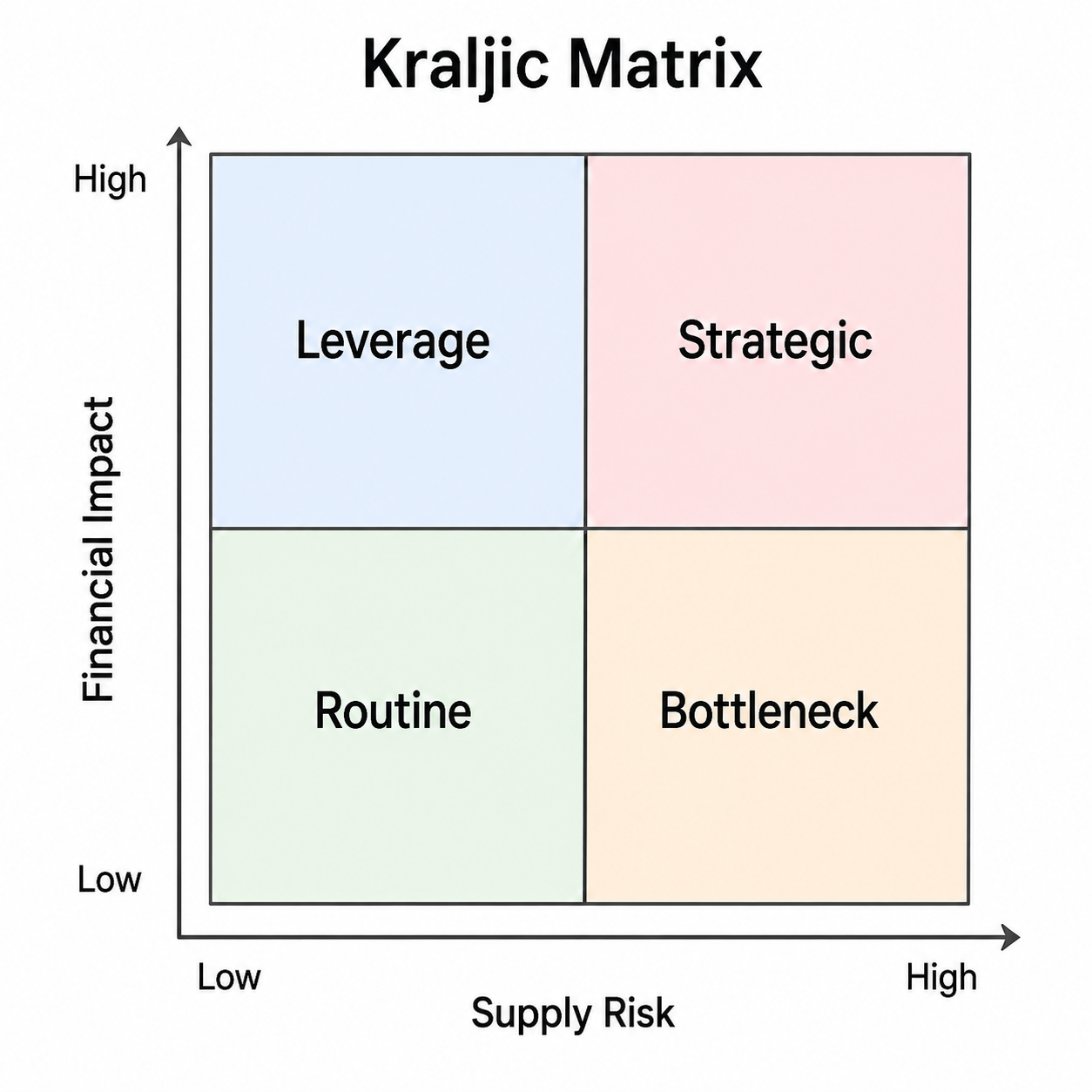
Together, these factors form the Kraljic Matrix, which places purchases into four categories: routine, leverage, bottleneck and strategic.
Sarah and Ahmed classify the purchases
Ahmed: Office stationery has low expenditure and many available suppliers.
Sarah: That means low financial impact and low supply risk. It is a routine purchase.
Ahmed: We should use a simple and efficient buying process.
Sarah: Correct. Too much administration could cost more than the stationery itself.
Ahmed: Cleaning materials are available from several suppliers, but our annual spending is high.
Sarah: That makes them a leverage purchase. Competition gives us an opportunity to negotiate better prices and terms.
Ahmed: The specialised production sensor has low annual spending, but only one approved supplier.
Sarah: Its financial impact is low, but its supply risk is high. It is a bottleneck purchase.
Ahmed: We should focus on availability rather than demanding the lowest price.
Sarah: Yes. We may hold a spare unit, monitor the supplier and search for an approved alternative.
Ahmed: Packaging material has high expenditure and is essential to production.
Sarah: How serious would a supply failure be?
Ahmed: Very serious. Products cannot be delivered without safe packaging.
Sarah: Then it may be strategic, especially if changing suppliers requires testing and customer approval.
Ahmed: So strategic purchases need stronger relationships and longer-term planning.
Sarah: Exactly. The category helps us select the right procurement approach.
The four categories
| Category | Financial impact | Supply risk | Typical approach |
|---|---|---|---|
| Routine | Low | Low | Simplify ordering and reduce administration |
| Leverage | High | Low | Use competition and negotiate better value |
| Bottleneck | Low | High | Protect supply and develop alternatives |
| Strategic | High | High | Build close relationships and plan long term |
The classification is based on the organisation’s situation. The same item may belong to different categories in different organisations.
For example, bottled water may be routine for an office but strategically important during an emergency-response operation.
Sarah’s conclusion
Sarah: “The Kraljic Matrix helps us avoid treating every purchase in the same way. First, assess its financial impact and supply risk. Then use a procurement approach that matches its position. Simplify routine purchases, use competition for leverage purchases, protect bottleneck supplies and manage strategic purchases through planning and strong supplier relationships.”
Key knowledge
-
The Kraljic Matrix considers financial impact and supply risk.
-
Routine purchases require efficient administration.
-
Leverage purchases provide opportunities to use competition.
-
Bottleneck purchases require supply protection.
-
Strategic purchases require close management and long-term planning.
-
Classification should be reviewed when markets, suppliers or organisational needs change.